My Research
My work advances educational practice and theory through design-based research, participatory methods, and critical engagement with digital technologies. I specialize in AI literacy, media education, inclusive instructional design, and teacher professional development, with a commitment to bridging pedagogical innovation and empirical rigor. My research addresses the following areas:
- AI Literacy and Teacher Education—Impact on AI in education, teacher AI competencies, critical use in pedagogical contexts
- Game-based Learning—Serious games, proximal development in play, constructionist approaches
- Interactive Digital Storytelling—new expressive forms in digital media, electronic literature for children, interactive storytelling systems
- Inclusive Design—Instructional design of educational media, Universal design for learning (UDL)
- New Literacies Studies—literacies as social practices, literacy beyond print, multimodal meaning-making
- Science & Technology Studies in Education—sociological perspectives on educational technology and digital governance, socio-materiality, actor-network theory (ANT)
Current Research Program
AI Literacy in Teacher Education
As Co-Principal Investigator of AI2PI: From Artificial Intelligence to Pedagogical Innovation (€1.49M, EACEA Erasmus+ Teacher Academy, ID: 101196121), I coordinate an international consortium of 9 partner institutions across 7 countries. This project develops blended learning modules and open educational resources to support teachers' AI literacy, addressing the urgent need for pedagogically grounded approaches to AI integration in education. The project employs design-based research to iteratively develop, test, and refine professional development materials with practicing teachers across diverse European contexts.
Digital Literacies and Media Education
My research investigates how children develop critical digital literacies through creative engagement with interactive technologies. Building on my dissertation work (MEKIDS, completed 2023), I investigate narrative computational thinking, examine digital storytelling and XR-environments as pedagogical tools, and engage with children's participatory design practices. Recent publications examine how multimodal composition supports social-emotional learning and how young learners conceptualize computational concepts through storytelling.
Concluded Projects
MEKIDS: Media Education with Kids through Interactive Digital Storytelling
PhD in General Pedagogy, Social Pedagogy, General Education and Disciplinary Didactics (cum laude), Free University of Bolzano, 2023
This design-based research study developed and evaluated an interactive digital storytelling tool co-designed with primary school children. The project demonstrated how participatory design approaches enable children to become active designers of educational technology while developing multimodal literacy competencies. Key findings reveal the pedagogical potential of interactive narratives for curriculum-related reflection and the challenges of promoting critical digital literacies within authentic school contexts. The research produced the Fantastinomio, an open-source interactive storytelling system that remains in active development and use in primary classrooms.
Selected Publications
See ORCID | CV for a complete list
Published Papers (Open Access)
- Schlauch, M., Sylla, C., & Gil, M. (2024). More than words: Conceptualizing narrative computational thinking based on a multicase study. International Journal of Child-Computer Interaction, 33, 100704. doi:10.1016/j.ijcci.2024.100704
- Scharfenberg, J., Stadler-Altmann, U., Plank, K., & Schlauch, M. (2024). The normative-empirical divide: What we (don't) know about the internationalization of teacher education. Lehrerbildung auf dem Prüfstand, 17(2), 159-168. doi:10.62350/SLRG8956
- Schlauch, M., 2023. MEKIDS: Media Education with Kids through Interactive Digital Storytelling , a Design-Based Research Study. Ph.D. thesis. Free University of Bolzano. Bildungsforschung,(2). https://hdl.handle.net/10863/36753
- Deister, F. L., Garzetti, M., & Schlauch, M. (2022). Conjecture maps in practice: Planning, conducting and assessing educational design research. Bildungsforschung, (2). doi:10.25539/bildungsforschung.v0i2.893
- Schlauch, M. (2021). The Unlucky Hans. The Difficulties of Adapting Fairy Tales as Text-Based Games for Young Readers. gamenvironments, 2021(15), 351-361. doi:10.48783/gameviron.v15i15.156
- Schlauch, M. (2021). Digitale Bildung im Nachlass der Lehrmaschine. Lehrerbildung auf dem Prüfstand, 14(1), 94-102. open access
- Schlauch, M. (2021). Towards the end of school? Using Social Science Fiction to explore pedagogical perspectives on technology. formazione & insegnamento, 19(2), 169-178. doi:10.7346/-fei-xix-02-21_16
- Schlauch, M. (2019). Learning as a Matter of Concern: Reviewing Conventional, Sociocultural and Socio-material Perspectives. Tecnoscienza, 10(2), 153-172. open access
Select Publicly-Available Talks
- [Nov. 2023] Videobooks: Augmenting the reading experience with synchronous reading and listening, South Tyrol Free Software Conference, SFSCON 2023
- [Nov. 2022] Educational design research and Twine: Developing the "Fantastinomio" for digital storytelling in schools., South Tyrol Free Software Conference, SFSCON 2022
Software & Open Educational Resources
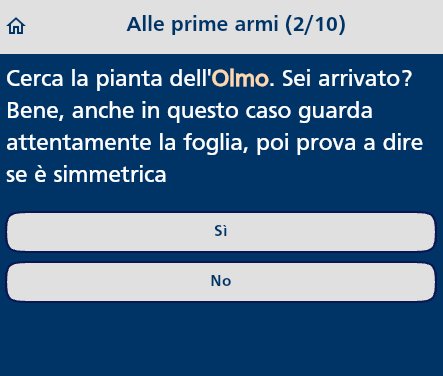
Chi Vuol Esser Centenario:
Mobile quiz application for mathematics education during guided tours of University of Milan buildings, commissioned by Departments of Mathematics and Computer Science. Location-based questions designed for on-site engagement without device tracking. Built with Python Flet/Flutter for cross-platform deployment. [Demo] [Project Page]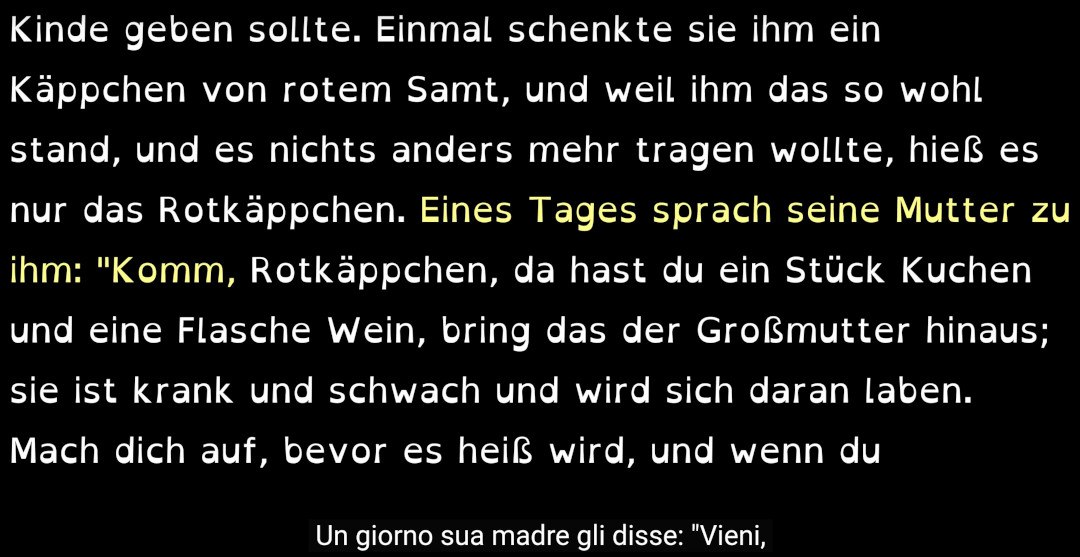
Smart Videobooks:
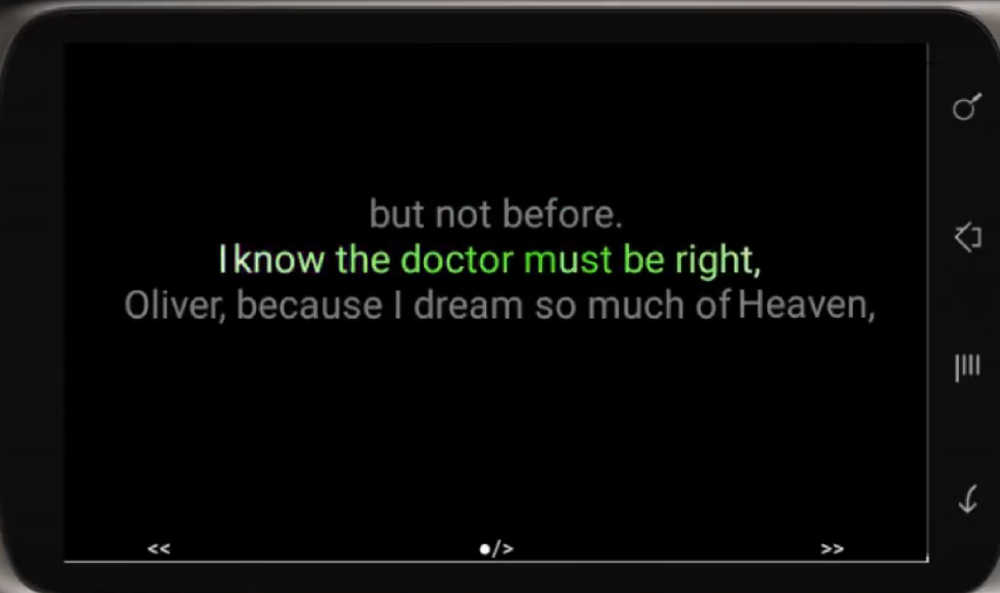
Digital library of public-domain literary works with synchronized video, text-to-speech, and multilingual subtitles for multimodal reading support, implementing advanced ML programming techniques for multimodal alignment. Tested with secondary language classrooms in Berlin. [Library]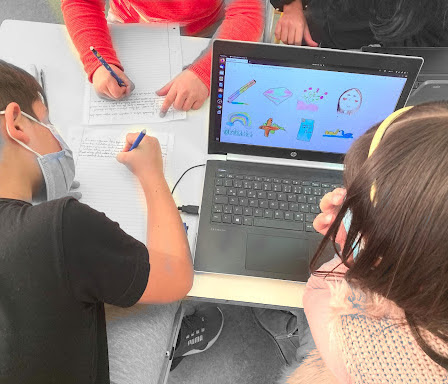
Fantastinomio:
Hypertextual interactive storytelling tool for primary education (ages 7-12), enabling teachers to scaffold creative narratives around complex subjects. Developed through educational design research methodology and tested in classroom interventions. Open-source. [Demo] [Code]. Example teacher/student adaptations: for Social Emotional Learning (Braga, Portugal), for Math Education (Genova, Italy)